Showing posts with label Hyundai. Show all posts

Saturday, July 16, 2011

All Hyundai Veloster (i15) To Be Released Soon - Technical Specifications, Features

Detroit Motor Show, 2011, witnessed the debut of Hyundai's all new Veloster sports hatchback. The left-hand-drive version exhibited at the Detroit Auto Show had only one door at the drivers side(left side) and two doors on the passengers side(right side). The right-hand-drive version of the Hyundai Veloster which is to be released in Australia soon also is having only three doors, one at the driver's side and other two at the passenger's side. This distinctive Coupe will soon be seen in the roads of Australia.
Its Distinctive fluidic design, unique third door access, smart 1.6 direct-injection engine and advanced features that connect with the driver makes new Hyundai Veloster a 'one-of-a-kind' Coupe. The Coupe is more likely to continue Hyundai's 'i' branding in Australia, probably as Hyundai i15.
Let's have a glance at the features of new Hyundai Veloster or Hyundai i15:
The Australian version of the new Veloster also is likely to be powered by the new Gamma 1.6-litre direct-injection 4 cylinder petrol engine as the one shown in Detroit. Equipped with variable valve timing on both inlet and outlet valves, the engine also features electronic throttle control, roller timing chain and anti-friction coatings. Hyundai claims a best in its class specific output of 64.4kW per litre from the engine, which develops a maximum power of 103kW @ 6300rpm and maximum torque of 163Nm @ 4850rpm. This engine will be coupled with Hyundai's first dual-clutch automated transmission or a proprietary six-speed manual gearbox. Hyundai claims a fuel efficiency of 5.9L/100km in highway ride.
While the Veloster is described as a three-door vehicle for ease of explanation, it technically is a four-door hatch – three side doors and one at the back to access the boot.
The Electric power steering in Veloster is said to be tuned for sports driving and has a turning circle of 10.4 metres. Veloster comes standard with 17-inch alloy wheels, with two types of optional 18-inch wheels, one of which comes with painted inserts, a segment first. Six airbags – dual front, side and curtain – are standard, as is ESC and vehicle stability management (VSM).


HYUNDAI VELOSTER TECHNICAL SPECIFICATIONS

ENGINE

1197cc, 4 Cylinder, 16 Valve

CAR BODY TYPE

Hatchback

SEGMENT

B+ Segment

FUEL TYPE

Petrol

MAXIMUM POWER

103kW @ 6300rpm

MAXIMUM TORQUE

163Nm @ 4850rpm

SEATING CAPACITY

5

BRAKES

Front:- Disk

Rear :- Disk

TRANSMISSION

Automatic/5-speed manual

STEERING

Power

PRICE

Rs. 5,50,000/-


Tags:- Hyundai Veloster, Hyundai i15, Hyundai Veloster specifications, Hyundai Veloster technical specifications, Hyundai Veloster specs, Hyundai Veloster features, Hyundai Veloster price, Hyundai Veloster engine, Hyundai Veloster power, Hyundai Veloster torque, Hyundai Veloster transmission, Hyundai i15 specifications, Hyundai i15 technical specifications, Hyundai i15 power, Hyundai i15 features, Hyundai i15 price, Hyundai i15 engine, Hyundai i15 launch, Hyundai Veloster launch

Thursday, July 14, 2011

New Gen Y Buyer Survey Spells Trouble for Detroit


Auto pricing website TrueCar studied the car buying behaviour of four million Gen Y (18 to 27 year-old) over a twenty-four month period and here’s what they found.
Scion took the crown for top brand, with 37.4% of the market and for top model (the tC coupe), with 21.2%, while second place went to Mitsubishi (32.1%) and their Lancer sedan (20.3%).
Mazda was the third most visited brand for Gen Y buyers, though only 17th in terms of model. The top four vehicle choices were Japanese, with a German in seventh place and a South Korean in ninth.

Toyota and Honda want to Win Back Sales Share from Hyundai Sonata with New Models


Not too long ago, if someone told you that a South Korean model would challenge America’s best selling sedan, the Toyota Camry, you would have probably laughed in his or her face.
Needless to say, a lot has changed over the past few years with Hyundai and in particular its latest Sonata sedan, not only challenging, but this past May even surpassing the Camry in U.S. sales for the first time in history.
Of course, the fact that Toyota’s production capabilities were seriously affected by the aftermath of the March 11 earthquake, tsunami and nuclear disaster in Japan, played a significant role in Hyundai’s accomplishment.

Wednesday, July 13, 2011

Black Card Holders Just as Likely to own a Hyundai as a Bentley or an Audi


If you are one of American Express’ very special customers, and have US$16.3 million in assets and an annual household income of around US$1.3 million, you may be granted the privilege of one of their black Centurion Cards.
Simon Cowell has one, as does Kanye West, Denzel Washington and Lindsay Lohan. Interestingly, and of more concern to readers of this blog, you might also be the proud owner of a Hyundai.

During the course of a presentation at the South Korean automaker’s Ann Arbor engineering and research centre, Hyundai’s U.S. Chief John Krafcik revealed that some 6% of “Black Card” holders own a Hyundai – a percentage shared with those who own Bentleys and Audis.

Wednesday, June 22, 2011

All New Hyundai Verna Fluidic - Technical Specifications, Features, Price

Hyundai, second largest seller of 4-wheelers in India, recently introduced the renovated version of their sedan Verna. The new Verna Fluidic have entirely changed compared to its predecessor. The name of new Verna matches its design - Fluidic. Hyundai motors introduced first model of Verna in the year 2006. Though a model with modified design was brought last year, it was not a success in the Indian car market. Solving the defects of old model, Hyundai introduces all new Hyundai Verna Fluidic in 2011. Let's go through the features and specifications of new Verna Fluidic:

Design
The variety design of new Hyundai Verna Fluidic resembles Honda City, new Ford Fiesta, and a lot more concept cars. The new Hyundai Verna Fluidic is a blend of power and wildness. The major design features are traditional Hyundai grill, large head-lamps surrounding grills and Curved roof-line which gives a sporty look. The height of new Verna Fluidic has been reduced by 13mm. But the length has been increased by 70mm. Verna Fluidic's exterior as well as interior is a meld of comfort and luxury. No other cars in the same price range comes with curtain airbag. Parking camera with sensor, ABS, EBD, rear disk breaks, impact sensing door lock, clutch-locking system and 16 inch alloy tyres are features available in top models of Verna Fluidic. The variations made to the interior are astonishing. Quality of plastic has increased considerably when compared to old Verna. Seats have become more comfortable. But the seating position has been lowered a little. There is large leg space at the front as well as the rear. The platform which is almost flat promises comfortable journey with 3 passengers at the rear. Steering controls are similar to i20. The controls and dials are elegant. The new Verna has adequate USB charging ports. The dickie space is 465 litres. The most amazing feature of Hyundai Verna Fluidic is the comfortable journey it promises to the passengers at the front and rear. The suspension with gas-filled shock absorbers absorb nearly all shocks.


Driving
Hyundai's new generation gama petrol engines give priority to performance, mileage and emission control. The engine which offers a maximum power of 121bhp @ 6300rpm is the most powerful petrol engine in ts category. When Verna's engine has a power of 121bhp, the main rivals of it, Volkswagen Vento and Maruti Suzuki SX4 have a engine with power of 103bhp each. The engine which gives good response behaves as if it has been tuned for city driving. Breaking, handling in higher speeds and cornering are of superior standard.

Specifications

HYUNDAI VERNA FLUIDIC SPECIFICATIONS

ENGINE

4 Cylinder DOHC

DISPLACEMENT

1591cc

MAX. POWER

121bhp @ 6300rpm

MAX. TORQUE

154Nm @ 4200rpm

GEAR TRANSMISSION

5 - Speed Manual

SUSPENSION

Front:- McPherson Strut with Stabilizer Bar

Rear:- Couple Torsion Beam Axle

BRAKE

Front:- Disc

Rear:- Drum

TYRE

16” Alloy wheels (195/55 R16)

L x W x H

4370 x 1502 x 1475 mm

WHEELBASE

2570 mm

FUEL TANK CAPACITY

43 litres

PRICE

7.65 Lakhs (Cochin Ex-showroom price)


Price
  • Fluidic Verna 1.4 VTVT :- Rs.699,777
  • Fluidic Verna 1.6 VTVT : - Rs.765,350
  • Fluidic Verna 1.6 VTVT SX :- Rs.825,417
  • Fluidic Verna 1.6 VTVT SX (O) :- Rs.895,494
  • Fluidic Verna 1.6 VTVT SX (O) AT :- Rs.965,573
  • Fluidic Verna 1.4 CRDi :- Rs.809,899
  • Fluidic Verna 1.6 CRDi :- Rs.875,473
  • Fluidic Verna 1.6 CRDi SX :- Rs.935,539
  • Fluidic Verna 1.6 CRDi SX (O) :- Rs.1,005,616
  • Fluidic Verna 1.6 CRDi SX (O) AT :- Rs.1,075,693

Verdict
Suitable for all who look for a mid-size sedan.
Rating:4.3/5


Tags:- Hyundai, Hyundai Verna, Hyundai Verna Fluidic, Hyundai Verna Fluidic specifications, Hyundai Verna Fluidic technical specifications, Hyundai Verna Fluidic specs, Hyundai Verna Fluidic features, Hyundai Verna Fluidic price, Hyundai Verna Fluidic mileage, Hyundai Verna Fluidic variants, Hyundai Verna Fluidic engine, Hyundai Verna Fluidic power, Hyundai Verna Fluidic torque, Hyundai Verna Fluidic design, Hyundai Verna Fluidic test drive, Hyundai Verna Fluidic review

Tuesday, April 26, 2011

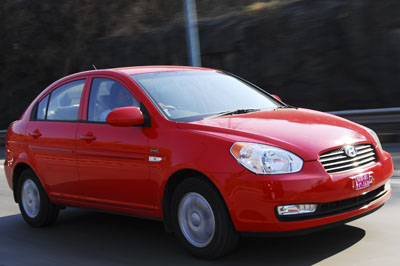
Hyundai Verna

Exotic Hyundai Verna With Silver Color

Hyundai Verna Luxury Interior


Hyundai Verna Beautiful Lighting

Hyundai Verna Steering Wheels

Luxury Hyundai Verna

Hyundai Verna Transform With High Technology

Glossy Blue Hyundai Verna

Red Hyundai Verna On The Road

Hyundai Verna Show Up

Hyundai Verna

Exotic Hyundai Verna With Silver Color

Hyundai Verna Luxury Interior


Hyundai Verna Beautiful Lighting

Hyundai Verna Steering Wheels

Luxury Hyundai Verna

Hyundai Verna Transform With High Technology

Glossy Blue Hyundai Verna

Red Hyundai Verna On The Road

Hyundai Verna Show Up

Saturday, April 23, 2011

Hyundai Elantra

The Hyundai Elantra in South Korea, is a compact car from Hyundai of South Korea launched in October 1990 for the 1991 model year, and now in its fifth generation. The Elantra was formerly marketed as the Lantra in Australia and some European markets. In Australia, this was due to the similarly named Mitsubishi Magna Elante model. This gave rise to disagreement from other motor manufacturers, and the name was standardized as "Elantra" worldwide in 2001 (with the exception being Korea and Malaysia still selling under the name "Avante"). Launched in 1990 , the Elantra (codename J1) received a mid-term facelift in 1993. The Elantra was powered by a Mitsubishi-designed 1.6 L (1596 cc) straight-4 This DOHC 16-valve 1.6 L unit produced 113 hp (84 kW) at 6000 rpm and could push the Elantra to 60 mph (97 km/h) in 9.5 seconds. The quarter-mile (0.4 km) run took 17.1 seconds and produced 80 mph (129 km/h). Top speed was 116 mph (187 km/h). The Elantra got 22 mpg[clarification needed](10.7 L/100 km) in the city cycle. Starting in 1993 there was also a Mitsubishi-designed 1.8 L (1836 cc) straight-4 engine available the 1.8L unit that produced 124 hp (99 kW) at 6000 rpm. Launched in 1995, the second generation (codename J2) was offered as a sedan and station wagon. It was sold in the Korean market as the Avante in sedan form and Avante Touring in station wagon bodystyle. Between 1996 and 1998, the Elantra was marketed as the Bimantara Nenggala (1.8 litre petrol) in Indonesia. (The Cakra (1.5 litre petrol) was based on the Accent (X3).)

An all-new model (codename XD) was launched in 2000. The wagon was dropped in favor of a five-door hatchback. Starting in 2001, all American models came with standard front and front side airbags, air conditioning, power locks, power windows and power steering. This simplified dealer inventories and repairs and also sought to improve Hyundai's image of 'value' cars. In 2003, the Elantra received a facelift for all models (codename XD2). The facelift gave the Elantra new headlights and taillights, a new grille, new front and rear bumpers, a refreshed hood and trunk, and a refreshed dashboard. A redesigned Elantra sedan (designated HD) debuted at the 2006 New York Auto Show for model year 2007. In North America, the Elantra also offers the most interior room in its class, leading the United States Environmental Protection Agency (EPA) to classify it as a mid-size car. Beijing Hyundai launched a redesigned Elantra called the "Hyundai Elantra Yue Dong" for the Chinese market with an updated exterior. The engine lineup includes 1.6- Gamma and 2.0-liter Beta II gasoline inline-four engines, and a 1.6-liter turbodiesel inline-four. Only the 2.0-liter engine is offered in North America. All engines feature improved fuel economy over previous versions. A five-speed manual transmission is standard and a four-speed automatic is optional. Hyundai began producing the Avante "LPI Hybrid" and it was launched in the South Korean domestic market in July 2009. The Avante LPI (Liquefied Petroleum Injected) is the world's first hybrid electric vehicle to be powered by an internal combustion engine built to run on liquefied petroleum gas (LPG) as a fuel. The Hyundai Avante LPI is a mild hybrid and the first hybrid to adopt advanced lithium polymer (Li–Poly) batteries.

Hyundai offers a Hyundai i30 wagon in the US and Canada marketed as the "Elantra Touring". Elsewhere, the same vehicle is marketed as the Hyundai i30cw.The fifth generation Avante, codenamed "MD", debuted at the 2010 Busan International Motor Show in April 2010. It features a 1.6L gasoline direct-injection engine, producing 103 kW (138 hp) and 167 Nm (123 lb-ft) torque, mated to a new 6-speed automatic or a 6-speed manual transmission. The design continues Hyundai's "fluidic sculpture" styling theme first seen in the 2011 Sonata. The new model went on sale in August 2010 in South Korea, and is expected to begin selling between end of 2010 and early 2011 as a 2011 model. The US version of the fifth generation Elantra debuted at 2010 Los Angeles Auto Show. It is powered by a new 1.8L Nu engine producing 148 hp (145 hp-PZEV) and 131 lb-ft (130 lb-ft-PZEV). EPA estimates for the new Elantra are 29 mpg-US (8.1 L/100 km; 35 mpg-imp) in the city and 40 mpg-US (5.9 L/100 km; 48 mpg-imp) on the highway. The fuel economy was increased with a low coefficient of drag, just 0.28. The Elantra will be available in two trim levels-GLS and Limited. Some of the premium features will be heated front and rear seats, proximity key entry with electronic push button start with immobilizer, navigation with touch screen. Mitsubishi Motors of Australia complained that Elantra was too close to its Elante trim level (last used on the 1991 Magna), and Lotus (as well as Kia) in the UK and Europe suggested it was too close to its Elan name, and its Kia counterpart. By 2001, both the Elan and the Elante had ceased production but the Avante's renaming remained necessary as Audi owned the Avant name in Europe.